Sunday, February 10, 2013

Warm up for Monday! Classifying Finches

Warm up for Monday:

Suppose you found a species of animal that you had never seen before. How would you identify it? Scientists use a tool called a taxonomic key to determine an organism's identity. A key uses a set of statements that describe an organism's appearance to help identify the organism.

Most taxonomic keys are dichotomous, which means they offer only two choices for a specific feature. You select the most correct possibility and follow the directions through to another statement. Eventually, you create a route through a series of statements that ends at the correct name of the unknown organism.

Warm up question 1:
 Pick one finch. See if you can figure out which species of finch it is:


Finch Identification
1.a. The beak is relatively long and slender.arrowCerthdea sp.
b. The beak is relatively stout and heavy.arrowGo to set 2
2.a. The bottom surface of the lower bill is flat and straight.arrowGeospiza sp.
b. The bottom surface of the lower bill has a bendarrowGo to set 3
3.a. The lower edge of the upper bill has a distinct bend.arrowCamarhynchus sp.
b. The lower edge of the upper bill is mostly flat.arrowPlatyspiza sp.

Warm up question 2:
Which do you prefer using: the dichotomous key above or the picture identification guide for figuring out salamander species in the lab on Friday?

Warm up activity:
We'll check out this site and play a finch beak game as a class.

You now have the remainder of class to work on your lab.

1) Finish collecting data.
2) We'll discuss how to make a scatter plot.
3) Then, you will work silently on your lab. You have scrap paper at your table. If you have questions, write them down and give them to me or your lab partner.

At the end of the period, turn in your lab. We will finish them tomorrow.

Happy SCIENTIFIC THINKING Monday!!!

Ms. Nickel

Source:
http://www.pbs.org/safarchive/5_cool/galapagos/g53_more.html 

Wednesday, February 6, 2013

Finches of the Galapagos

Hey All-Stars!

Question One (discuss): What do you already know about Darwin's finches?

Today we'll learn a bit more and you'll get a little background for your lab and Project Part D.

Question Two (doodle): 
First, pretend you are a finch. What would your beak look like if you ate seeds? Insects? Flowers? Leaves? The blood of seabirds?


On the various islands of the Galapagos, these were available food sources on different islands. Over time, certain variations helped finches survive and have offspring. Eventually the birds became so different that there are now at least 15 different finch species in the Galapagos. There are vampire finches and seed-eating finches and everything in between!

From the common ancestor, the finches experienced adaptive radiation.
This image shows the ancestor and current finches of the Galapagos and their food sources.
Question Three (define in your notes): In your own words, after watching this video, describe adaptive radiation.

Question Four (write in your notes): What caused adaptive radiation?
Question Five (discuss and write in your notes): How would you classify and sort the finches to figure out which other finches they are related to?

This phylogram shows is one way that scientists classified the finches:
Simple phylogenetic tree of finches. 
Scientists can look at genetic similarities, morphology (physical characteristics), and more to determine how species are related. The lines can show percent similarity in DNA. 

When you create your phylogenetic tree (and we'll have more practice with this), you'll think about what current species would be the ancestor for your species in the future.

Question Six (discuss): How would you design a Darwin's finches video game? How would a finch move to the next level?

If you want more explanation of natural selection and finches, watch this video:

We'll spend the rest of class preparing for our lab tomorrow. SALAMANDER SEARCHING!

Happy Thursday!

Ms. Nickel


Monday, February 4, 2013

Welcome to the Galapagos!

Welcome to the Galapagos, All-Stars!

Today we'll be exploring the Galapagos. What did Darwin see? What have scientists noticed since then?


Instructions: Read about the Galapagos. Work with your table to figure out what type/s of tortoise live on your island. Write the answers to the questions in your science notebook. These will be checked tomorrow.

Introduction
Darwin visited the Galapagos in the 1830s as a naturalist on board the HMS Beagle. Since then, scientists have learned TONS about the geology, ecology, and oceanography of the area.

The Galapagos Islands are on the Nazca Plate. The Galapagos Islands were created/are being created by a magma plume that is creating hotspot volcanoes. The oldest islands are San Cristobal and Espanola. Isabella is still active. Look at the Google map of the Galapagos Islands.

Where Darwin travelled

View Larger Map

The climate of the islands is closely tied to ocean currents around the islands.


Life on the islands is unique and fragile. The Galapagos islands are a major are of concern for conservation. 


Giant Tortoise Adaptation Mystery

With your table, see if you can determine which type of tortoise would live on your island.
Tall Prickly Pear Cactus

Many of us have heard of Darwin’s finches but equally important to Darwin’s observations were tortoises.

Giant tortoises in the Galapagos eat prickly pear cacti. There are two types of prickly pear cacti. One type grows low to the ground, sprawling out. It grows in richer, wetter soils. The second is taller with thick bark and fruit only at the top. This variety grows in dry and wet areas.
Shrubby Prickly Pear Cactus


Human activity and feral animals (goats, pigs, etc.) are causing the tortoise numbers to fall.
There are two main types of tortoises - tortoises with saddle-shaped shells and tortoises with dome-shaped shells.


Saddle-back Tortoise

Saddle-Backed Tortoises:

The saddle-shaped shelled tortoises are more common. They have necks that are longer and that can stretch further because their shells allow more space for stretching. They tend to live in arid (dryer) climates. Saddle-backed tortoises are more aggressive than dome-backed tortoises. They have contests to see who can stretch their neck higher.

Dome-Backed Tortoises:
The dome-backed tortoises tend to live in moister highlands. They eat plants that are lower to the ground. Dome-backed tortoises are calmer than saddle-backed tortoises. Dome-backed tortoises are built like tanks that can smash through dense underbrush. Generally, dome-backed tortoises are smaller than saddle-backed tortoises.

Dome-backed Tortoise

Questions:
1) Which tortoise do you think is well-adapted to survive on your island? What evidence is there to support your conclusion?
2) Why might you see different tortoise types on one island?
3) Coevolution is when two species evolve with certain traits because of how they live together. Discuss with your group how you think the prickly pear cacti and tortoises may have coevolved. Write down what you think.
4) Look back at the map of the islands. Which direction is the Nazca plate moving?
5) What type of rock are these islands mainly made out of?
6) How does geology and climate affect biology?

Prepare to tell the class about your island and which tortoise would live on it.

Happy Exploring!

Ms. Nickel

Sources:


Geology Words - Review Part 1

Hey All-Stars!

Here are the terms that need to be in the back of your notebook by the test date. All of the definitions are in your note and/or on my blog so, you can find them pretty easily.

1) Seafloor spreading
2) Convergent plate boundary
3) Divergent plate boundary
4) Transform plate boundary
5) Absolute dating
6) Relative dating
7) Half-life
8) Igneous rock
9) Metamorphic rock
10) Sedimentary rock
11) Index fossil
12) Unconformity
13) Weathering
14) Erosion
15) Deposition

Good luck reviewing!
Ms. Nickel

Sunday, February 3, 2013

Introduction to Evolutionary Biology

We've explored how landforms change over time - from plate tectonics to weathering, erosion, and deposition. We looked at the geologic time scale and how scientists figured out the age of the Earth. Now, we'll focus on how life has changed over time.

Within the following reading are tasks for you to do. Please do these in your science notebook.

Task 1: Read the following and create a Venn diagram showing similarities and differences between unicellular and multicellular organisms.

Unicellular organisms were the first living organisms on Earth. There were tons of types, but they were each made of only one cell that did EVERYTHING. Unicellular life first appeared 3.8 billion years ago! Most life on Earth is still unicellular. We'll talk more about these unicellular organisms in the next unit.
A unicellular organism
Multicellular organisms are first evident in the fossil record 1.2 billion years ago. At first life was restricted to the oceans and other bodies of water. In multicellular organisms, different cells have different jobs. Cells are organized into tissues which make up organs which make organ systems which make...organisms. Tiny seaweeds were the first multicellular organisms. The first animals were kind of like today's jellyfish.
Organization in multicellular organisms.
All life needs water, energy, materials, and space to live.
Life moved out of water about 500 million years ago. To move out of the water, life had to develop structures to get water - like roots in plants. Fungi evolved that could absorb water from its surroundings.
Scientists think insects were next, followed by amphibians and reptiles, then mammals and birds.

Task 2: List the two mass extinctions and one fact about it.

We discussed mass extinctions during the Geologic Time Scale Gallery Walk - but let's review. Mass extinctions are when MANY life forms die out in a short time period. Two major mass extinctions are evident in Earth's past.
After the Permian, 90% of all living species died out. Scientists believe this is because all the continents were in a supercontinent (PANGEA!) which changed the climate.
After the Cretaceous a giant asteroid hit the Earth changing the climate and causing other catastrophes (tsunamis) that wiped out many living organisms (dinosaurs).
Mass extinctions allow different species to diversify.

Task 3: List 3 scientists who led the way to understanding how life changes over time.
Lamarck

In the early 1800s, Jean Baptiste de Lamarck noted that fossils seemed to show change over time. He thought that if a giraffe stretched its neck to reach leaves it's neck would get longer during one lifetime and pass its stretched neck down to its offspring. He had no evidence to support this.

Simultaneously, Gregor Mendel was studying traits of peas and how traits could be passed on. People did not take his ideas seriously because they went against the most common ideas about inheritance of the day.
Charles Darwin voyaged on the HMS Beagle and observed the diversity of life, especially on islands. This led to him developing the theory of evolution by natural selection.


Task 4:
1) Write this in your notebook: Evolution by natural selection is a scientifically accepted _____________.
2) List 3 types of evidence for evolution by natural selection.

Today, evolution by natural selection is a scientifically accepted theory. There is a lot of evidence for it. This includes fossil evidence, embryological evidence, and DNA evidence. We'll talk more about these later.


Task 5: Watch the video focusing on one part of cells dividing. How do you think variation occurs in living organisms? We'll discuss this more in class. Don't be afraid to be wrong. Just write something :-).


Task 6: Define the following in the back of your science notebook. This unit is called "Geology and Evolutionary Biology".

Evolution: the process through which species change over time, this change is due to genetic variations that are passed down
Natural selection: some traits help species survive long enough to successfully reproduce, overtime that trait becomes more common in a species
Adaptation: any inherited trait that gives an organism an advantage in its particular environment
Speciation: the evolution of a new species from an existing species

When you finish this, please work on the geology review materials or missing work.

Happy Monday!

Ms. Nickel

Source: Textbook (McDougal Littell Science Grade 8, Unit B, chapter 1)


Weekly Announcements: Feb 4-8

Hey There All-Stars!

Here's some EXCITING NEWS!
I'm pushing back some due dates and test dates so READ THE ANNOUNCEMENTS CLOSELY!

This week we'll answer the following questions...

Monday: How do we know about how life has changed?
Tuesday: Who was Darwin and what did he notice?
Wednesday: How can we observe natural selection? (GUEST PRESENTER! GET EXCITED!)
Thursday: What can we learn from salamander diversity?
Friday: Why are there so many salamander species?

Assignments due:

Monday: Peanut Butter and Jelly Rock Layers lab
Wednesday: Science notebook check during class!!!!
FRIDAY (this changed!): Project Part C
Tuesday, February 12: Salamander Lab
Thursday, February 14 (this changed!): Project Part D
Wednesday, February 20: Test on Evolutionary Biology and Geology

                                                Is there anything that doesn't change over time?

Happy Super Bowl Sunday!

Ms. Nickel

Friday, February 1, 2013

Project Part C: Invent a Species of the Future!

Hey All-Stars!

I can't wait to see the species you invent! Remember that a 3-D species gets bonus points :-).

1) Create a word cloud and collage OR diorama to tell me about the biome of the place you chose in Part B. Show me the biotic (living things - these can be from 2013 or futuristic) and abiotic (non-living things - water, ice, the sun...) factors in your area.

Go here to figure out what biome your place might be. Remember to cite this site if you go to the link.

A note about Wordle - I prefer to use the advanced tab. If you do, you can put in numbers to make certain words really big. For example, if I chose to do a rainforest, I'd put "Rain: 100" and "Humid: 50" and "Trees: 75" in the box on the advanced page.
ALSO, YOU MUST PRINT wordles or save the URL somewhere. It's REALLY annoying to find them later. I know from experience.

Collage sample - A rainforest:
You may tear out magazine pictures to create your collage.
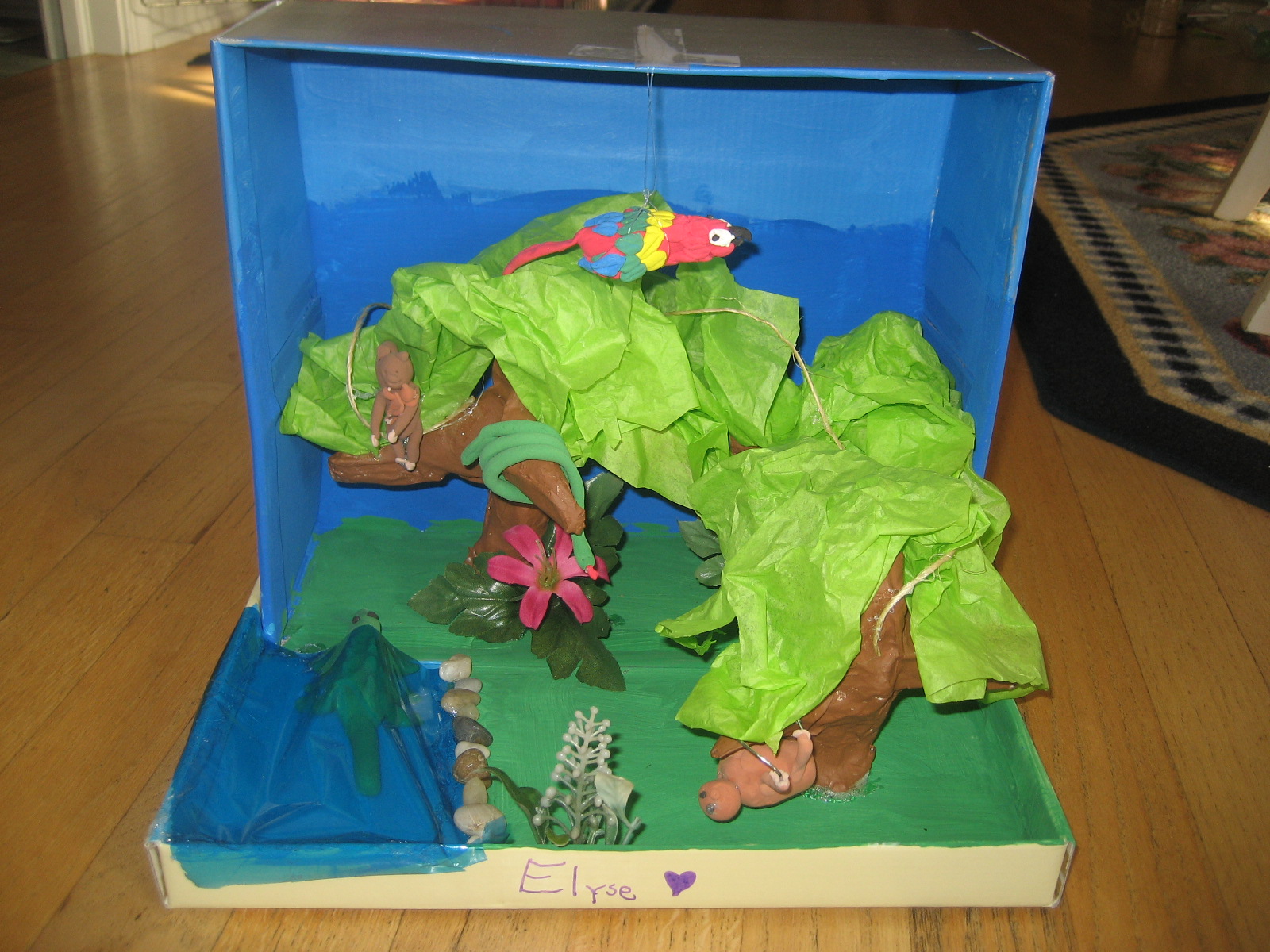
Diorama option example - A rainforest:
2) Create your species!
Think about what species would survive in your area. What would it be like?
Would it have: hair, fur, venom, claws, sharp teeth, thumbs, wings, a beak, a shell, scales, a tail?
Would it be able to: do math, swim, fly, hop, read, hibernate, make webs?
What does your species eat? What type of mouth and teeth does it need? Does it need teeth?
Where does your species live? In a burrow? Nest? Under a rock?
Now make your species. You can draw it WITH COLOR or create it with anything. You could use recycled materials, clay, aluminum foil, fabric, other stuffed animals (if they are YOURS and you no longer want them!).

Go here to see some neat, well-adapted animals! Remember to cite!
3) Write a species fact card!
Tell me about the species. What are 4-5 of its coolest, most important, live-saving, naturally selecting adaptations?
Why can your species survive in the area you chose?

IMPORTANT: Please don't go out and spend loads of money on this project! You can use all recycled materials. It's better for the Earth and for your budget! I have some materials available in my classroom (YAY Scrap Exchange!)

I AM SO EXCITED TO SEE WHAT YOU CREATE! I'm jumping up and down. LIKE ACTUALLY!

Two other things:
1) First person to chose what biome I should make a model for gets a Starbuck. Chose by posting below. Your post must be a real biome and it must tell me a joke (corny but appropriate) about that biome.
2) Watch this video!

Happy weekend! I really enjoy teaching ALL OF YOU! (Even if you have a case of loud-laugh-itis or I-can't-sit-because-blah-blah-itis").

Ms. Nickel